
Mohair is a luxurious natural fiber obtained from the long, silky fleece of the Angora goat (not to be confused with the Angora rabbit). Celebrated for its luminous sheen, strength, and soft hand, mohair has long been regarded as one of the most elegant and versatile animal fibers in the textile world. Its distinctive luster and ability to hold vibrant dyes make it a favorite for high-end fashion, upholstery, and specialty knitwear. Known as the “Diamond Fiber,” mohair blends the warmth and softness of wool with the smooth, glossy texture of silk.
The origins of mohair date back several millennia to Anatolia (modern-day Turkey), where the Angora goat was first bred around the 12th century. The word “mohair” is derived from the Arabic term mukhayyar, meaning “choice” or “select,” reflecting its status as a prized textile. By the 16th century, the fiber reached Europe, where it was used in royal garments and ecclesiastical robes. In the 19th century, Angora goats were introduced to South Africa and the United States (notably Texas), where mohair production flourished. Today, South Africa remains the world’s largest mohair producer, followed by Lesotho, Turkey, and the U.S.
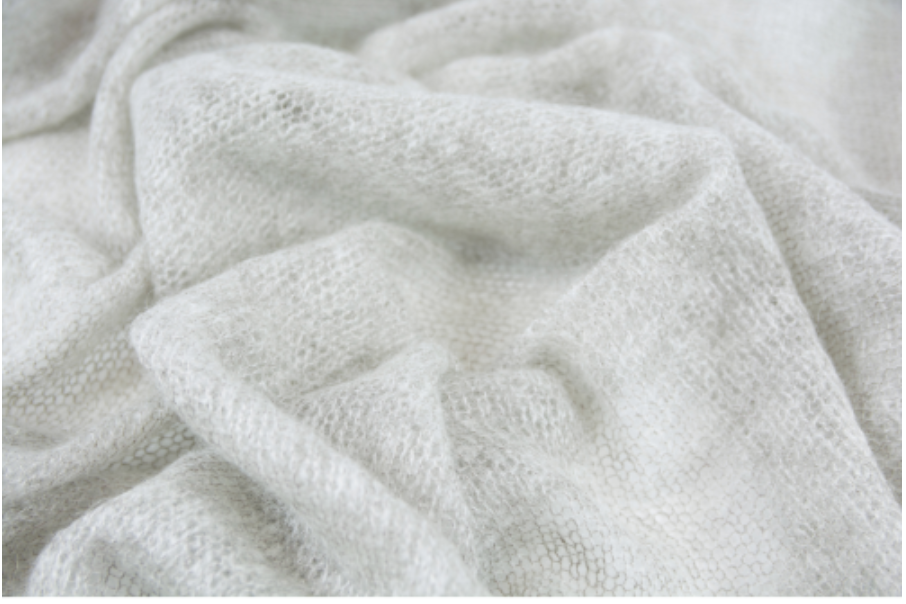
The mohair production process begins with shearing Angora goats, typically twice a year, in the spring and autumn. Each animal yields about 2 to 5 kilograms of fleece annually, depending on age and health. After shearing, the fleece is washed (scoured) to remove natural oils and dirt, then combed and sorted by fiber length and quality. The best-quality mohair comes from young goats, known as kid mohair, which is softer, finer, and shinier than adult mohair. Once spun into yarn, the fibers are ready for weaving or knitting, often blended with wool, silk, or synthetic fibers to enhance strength and texture.
Mohair’s unique properties set it apart from other types of wool. It has an exceptionally smooth surface and a natural sheen, reflecting light to give the fabric a subtle glow. The fibers are elastic, durable, and lightweight, with excellent insulating and moisture-wicking abilities. Mohair is warm in winter yet breathable in summer, making it suitable for year-round use. It is also highly resilient and resistant to felting, meaning garments retain their shape and luster over time. Mohair’s dye affinity is another hallmark; it absorbs color deeply, producing rich, luminous hues that make it ideal for luxury textiles and fashion pieces.
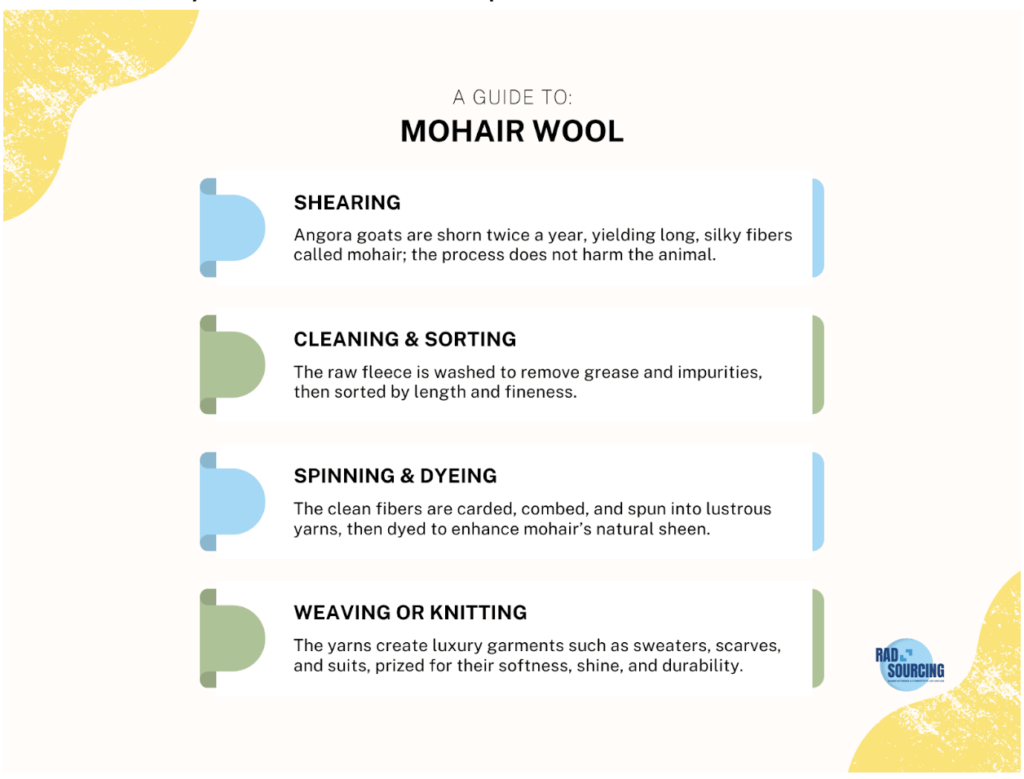
In fashion and interiors, mohair is used in a variety of applications, including sweaters, scarves, coats, and tailored suits, as well as in upholstery, curtains, and blankets. High-end designers appreciate its elegant drape and subtle sheen, which lend refinement to both formalwear and casual luxury. Kid mohair, being exceptionally soft, is often used for fine knitwear, while coarser grades of adult mohair are used for outerwear or furnishing fabrics. In upholstery, mohair velvet is especially prized for its durability and soft, plush pile, which is frequently seen in both antique and modern furniture.
From a sustainability and ethical standpoint, mohair is a renewable and biodegradable fiber, as goats are shorn without harm and their fleece regrows naturally. However, the industry has faced scrutiny over animal welfare practices, leading to the establishment of certification standards such as the Responsible Mohair Standard (RMS). This ensures humane animal treatment, sustainable grazing practices, and traceability throughout the supply chain. Many producers, especially in South Africa and Lesotho, have since adopted stricter welfare guidelines to maintain ethical integrity in mohair production.
The environmental footprint of mohair is relatively low compared to synthetic fibers, as it requires minimal chemical processing and is long-lasting, reducing the need for frequent replacement. Nonetheless, water use and land management remain important factors in maintaining sustainability. Initiatives in regenerative grazing and biodiversity protection help ensure that mohair production remains both ethical and ecologically responsible.
Globally, South Africa dominates the market, accounting for roughly 50–60% of the world’s mohair production. The semi-arid climate of the Karoo region is ideal for raising Angora goats, whose hardy nature allows them to thrive in dry, rugged terrain. Turkey maintains a rich heritage of mohair weaving, while Lesotho and Texas continue to contribute to niche, high-quality markets. The fiber is then spun and finished in European countries, such as Italy and the United Kingdom, where luxury mills transform it into fine yarns and fabrics for global fashion houses.
Mohair stands as a symbol of luxury, performance, and longevity, a fiber that captures light, retains warmth, and exudes natural beauty. Its combination of elegance, comfort, and resilience has kept it in demand for centuries, from royal robes to contemporary couture. As the textile industry adopts more ethical and sustainable practices, mohair remains a model of how natural fibers can strike a balance between refinement and responsibility, continuing to earn its title as the “Diamond Fiber” of fashion and design.