
Angora is one of the softest and most luxurious natural fibers, obtained from the coats of Angora rabbits. Not to be confused with Angora goats, which produce mohair, Angora rabbits yield an exceptionally fine and fluffy fiber prized for its silky texture, warmth, and halo-like appearance. The breed originated in Ankara (historically known as Angora), Turkey, where these rabbits were first bred centuries ago. By the 18th century, Angora rabbits had been introduced to Europe, particularly in France, where they gained popularity in textile production.
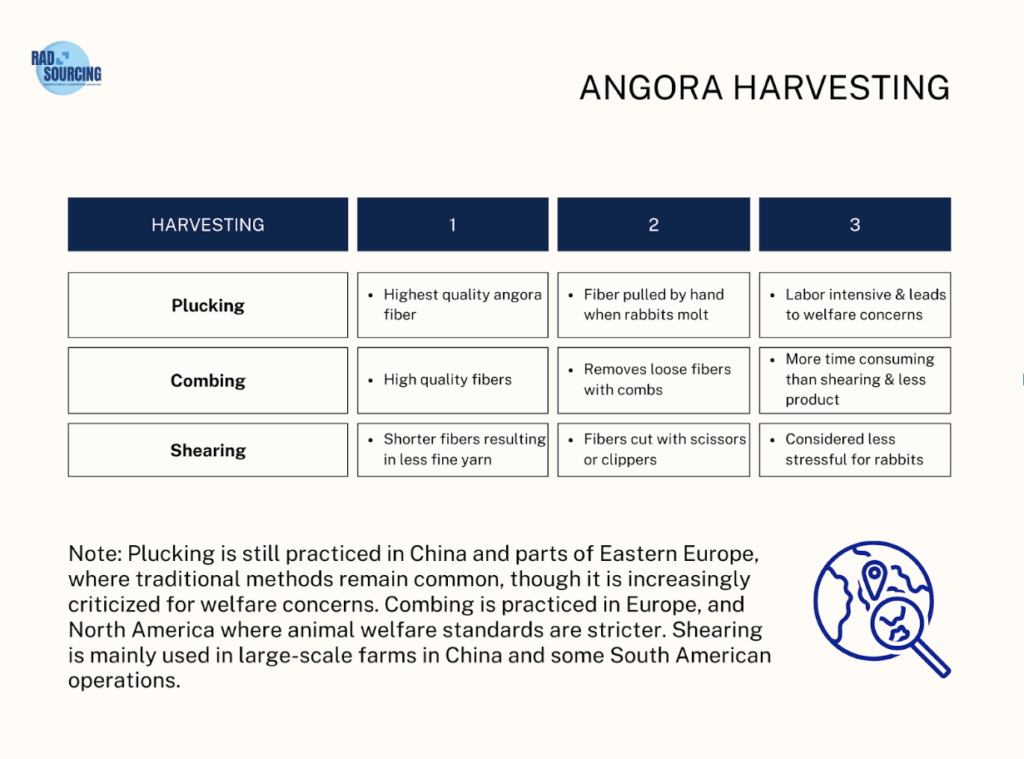
Angora fiber is harvested by combing, plucking, or shearing the rabbits, depending on the breed and specific husbandry practices. Plucking, the traditional method, involves removing the naturally shed hairs during molting seasons, producing the highest-quality fibers with the fewest coarse guard hairs. Shearing is faster and less stressful for the animals, but often results in shorter fibers that may contain more guard hair. On average, an Angora rabbit can produce between 200 and 400 grams of fiber per year.

Angora fiber is renowned for its extraordinary softness, often compared to cashmere but even finer in diameter. It has a distinctive fluffy halo and a lustrous sheen that makes it visually striking. The fiber is hollow, which contributes to its excellent insulating properties while maintaining a lightweight structure. Angora is also known for its ability to take dye beautifully, yielding vibrant, luminous colors.
Because the fibers are so fine and delicate, pure Angora garments can be fragile and prone to felting, matting, or shedding. For this reason, Angora is often blended with wool, silk, or synthetic fibers to enhance strength, elasticity, and durability while retaining its signature softness. Common blends are used in sweaters, scarves, hats, gloves, and other winter accessories. Pure Angora, however, remains highly valued in luxury knitwear.
From a sustainability and ethics perspective, Angora is a controversial product. While it is a renewable and biodegradable fiber, concerns about animal welfare have led to increased scrutiny of this material. Investigations in the 2010s revealed inhumane practices on some Angora farms, such as rabbits being plucked roughly or kept in poor conditions. As a result, many global fashion brands have banned Angora from their collections, and certifications or transparency in sourcing have become essential for ethical production. Responsible breeders emphasize humane plucking or shearing methods and proper rabbit care, ensuring their health and well-being.
Globally, China is the largest producer of Angora fiber, accounting for the vast majority of the supply. Smaller-scale, high-quality Angora production also occurs in Europe, particularly in France and Italy, as well as in South America. Due to declining demand in mainstream fashion, Angora is now more often seen in niche luxury markets and artisan production.
The applications of Angora are centered around knitwear and accessories, where softness and warmth are paramount. It is also used in luxury yarns for hand knitting and crocheting. Due to its lightness and halo effect, Angora creates garments with a distinctive, fluffy finish that is both fashionable and functional.
Angora embodies the intersection of natural luxury and ethical debate. Its incredible softness and warmth have made it a sought-after fiber for centuries, but its future depends on ensuring humane production and responsible sourcing that align with modern values of sustainability and animal welfare.