
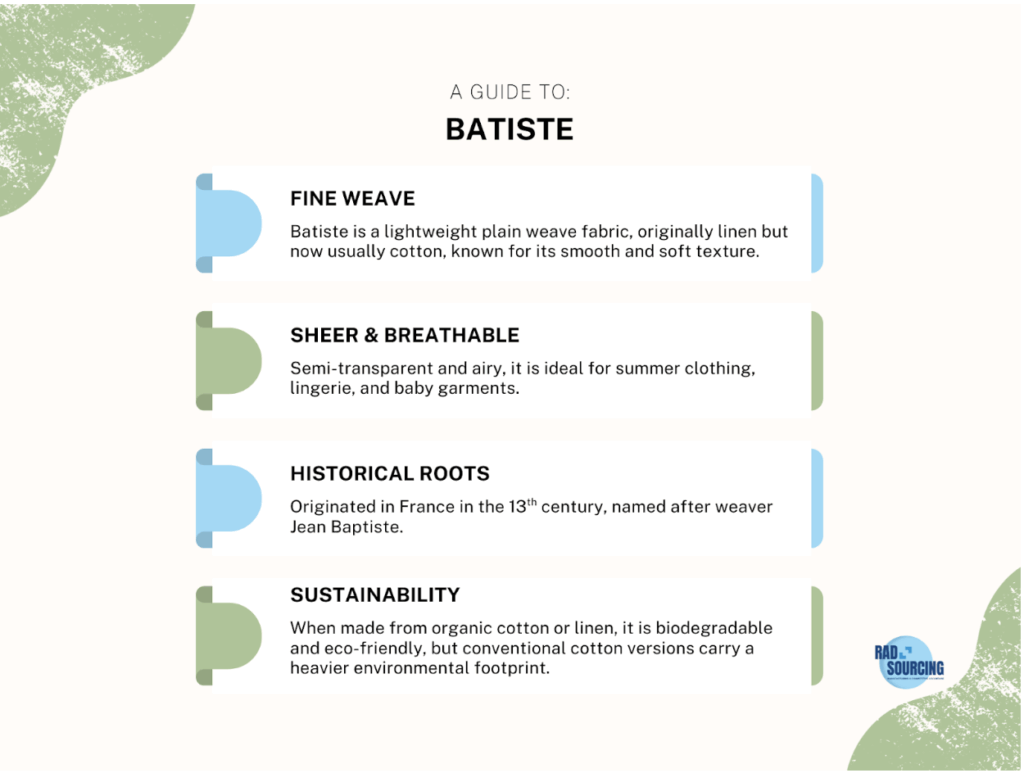
Batiste is a fine, lightweight fabric known for its smooth texture, breathability, and versatility in fashion and household textiles. Traditionally made from linen, batiste originated in France during the 13th century and is believed to be named after the French weaver Jean Baptiste, who perfected the delicate weaving technique. Over time, cotton became the primary fiber used for batiste, although variations made from silk and wool also exist. Today, cotton batiste remains the most common form, prized for its soft hand and semi-sheer quality.
Batiste is woven in a plain weave with very fine yarns, giving it a soft, smooth surface and a lightweight structure. The fabric is semi-transparent to opaque, depending on the thickness and fiber type. Compared to voile, which is similarly sheer, batiste has a slightly denser weave and a softer drape, making it especially comfortable for garments worn close to the skin.
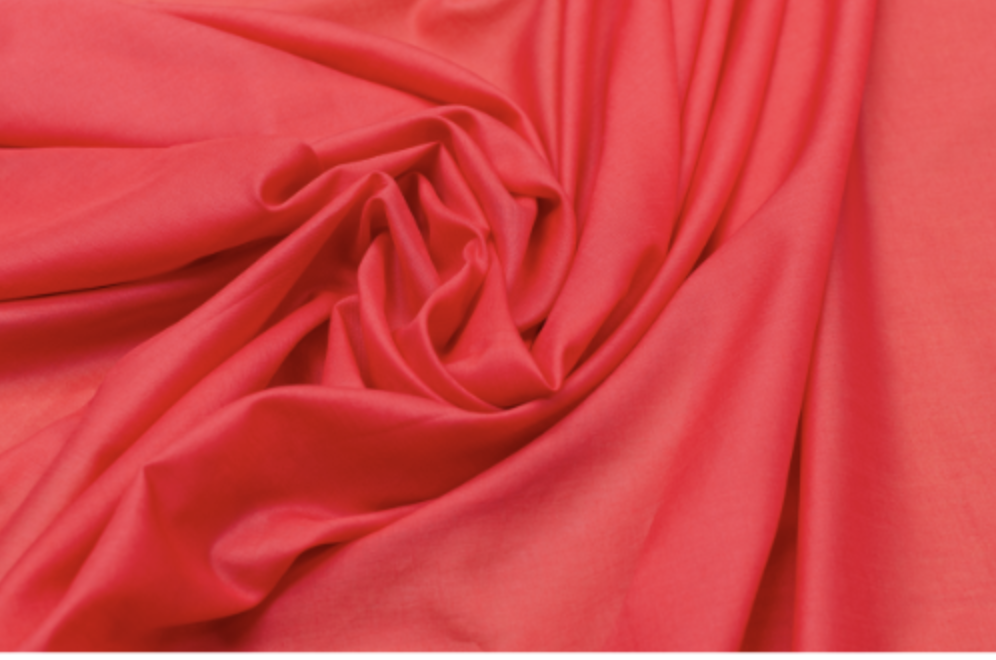
The properties of batiste make it ideal for warm-weather clothing and delicate applications. It is breathable, moisture-absorbent, and comfortable to wear, with a smooth hand that feels gentle against the skin. Its semi-sheer nature gives it an airy quality, while its softness makes it suitable for layering or lining. However, because of its fine weave, batiste is less durable than heavier cotton fabrics and requires careful laundering to maintain its texture.
Batiste has a long history in fashion, particularly in lingerie, nightwear, and infant clothing, where softness and comfort are priorities. In bridal and formal wear, batiste is often used as a lining fabric under lace or sheer outer layers. It is also common in summer dresses, blouses, and handkerchiefs. Beyond apparel, batiste is used in household textiles, including curtains, pillowcases, and decorative linens.
From a sustainability perspective, the impact of batiste depends mainly on the fiber content. Cotton batiste made from conventional cotton carries the environmental footprint of water-intensive and pesticide-heavy cotton farming. Organic or sustainably sourced cotton batiste, however, offers a more eco-friendly alternative. Linen batiste, derived from flax, is especially sustainable due to flax’s low water and pesticide requirements. All-natural fiber versions of batiste are biodegradable, giving them an advantage over synthetic alternatives.
Today, batiste is produced globally, with high-quality cotton batiste coming from regions such as Switzerland, known for its precision in fine cotton weaving, and India, which produces large quantities of lightweight cotton fabrics. European manufacturers often focus on luxury applications, while Asian producers supply affordable varieties for mass markets.
Batiste’s enduring appeal lies in its combination of lightness, softness, and versatility. Whether in intimate apparel, summer dresses, or home textiles, it provides an understated elegance that has kept it relevant for centuries.