
Cashmere is a luxurious natural fiber renowned for its unmatched softness, warmth, and lightweight feel. Sourced from the undercoat of cashmere goats, this rare fiber has been prized for centuries as one of the finest and most desirable materials in the world. Often associated with elegance and exclusivity, cashmere combines natural performance with indulgent comfort, making it a cornerstone of high-end fashion and luxury knitwear.
The history of cashmere dates back over 3,000 years to the high plateaus of Mongolia, Nepal, and Kashmir, from which the fabric takes its name. Nomadic herders in these cold regions first collected the goats’ soft undercoat during molting season to spin into yarns for shawls and garments. By the 18th and 19th centuries, cashmere shawls from Kashmir became highly coveted in Europe, particularly in France and Britain. The growing demand led to the establishment of specialized weaving and spinning industries in Scotland and Italy, which remain leaders in fine cashmere production today.
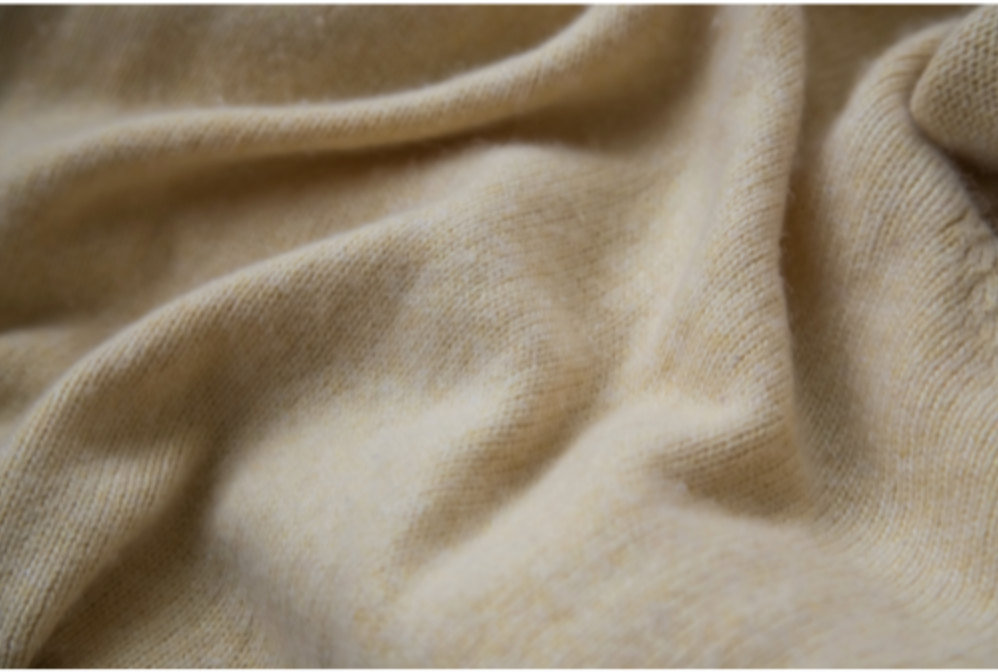
Cashmere fibers are obtained from the underdown layer of cashmere goats, which grows beneath their coarse outer hair to protect them from extreme cold. Each goat produces only about 150-200 grams of usable fiber per year, contributing to cashmere’s rarity and high cost. The fibers are collected either by combing during the natural shedding season in spring or by shearing, then sorted and cleaned to separate the fine undercoat from coarser guard hairs. The resulting fibers are exceptionally fine and remarkably soft to the touch.
The properties of cashmere make it one of the most luxurious textiles. It is softer, lighter, and up to eight times warmer than sheep’s wool, yet it remains breathable and gentle on the skin. Cashmere drapes beautifully, resists wrinkles, and has a subtle sheen that enhances its refined aesthetic. Because the fibers are delicate, cashmere garments require careful maintenance; they can pill with wear and should be washed gently or dry-cleaned. However, high-quality cashmere improves with age, becoming softer and more supple over time.
Cashmere is most commonly used in knitwear, such as sweaters, cardigans, scarves, and shawls, where its softness and warmth are most appreciated. It is also woven into suits, coats, blankets, and luxury accessories. In interior design, cashmere is used for throws and upholstery in high-end settings. Blends with wool, silk, or cotton are also popular, offering a balance between cost, durability, and softness while retaining the signature feel of cashmere.
Culturally, cashmere has long been associated with elegance, craftsmanship, and exclusivity. The traditional Kashmiri pashmina shawl remains one of the most treasured examples of handwoven luxury textiles. European mills, particularly in Scotland (Johnstons of Elgin) and Italy (Loro Piana, Brunello Cucinelli), have refined spinning and finishing techniques to produce some of the world’s softest and most consistent cashmere fabrics. In modern fashion, cashmere is no longer confined to luxury labels; it has entered everyday wardrobes through mass-market and sustainable brands seeking to democratize high-quality fibers.
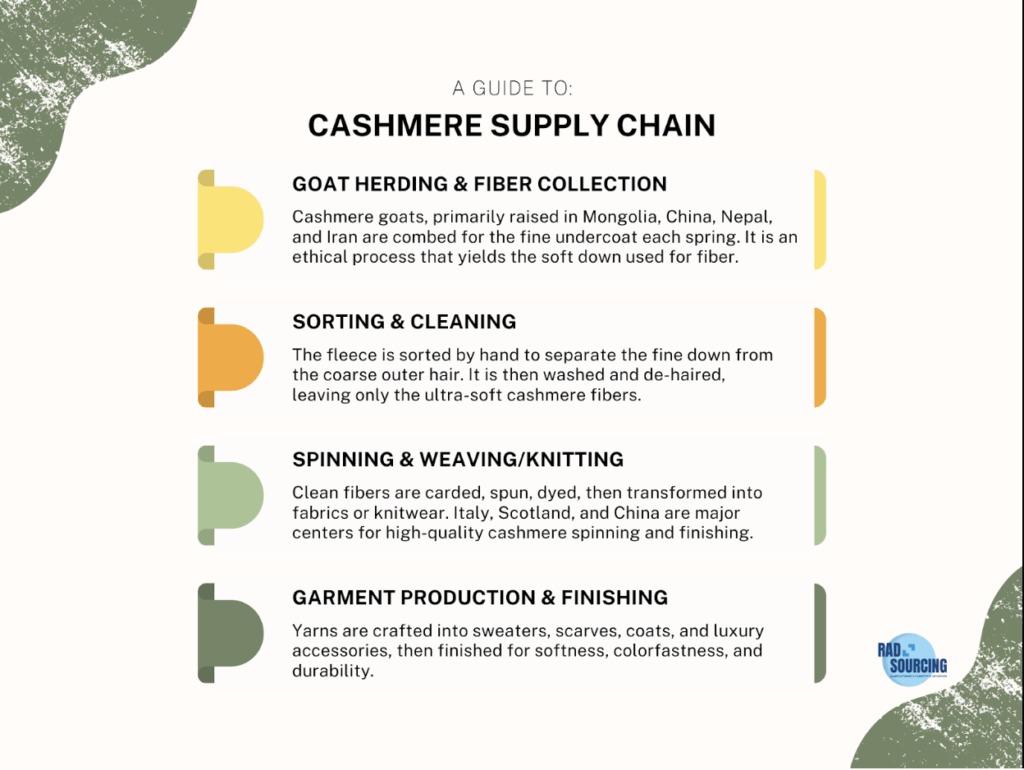
From a sustainability perspective, cashmere presents both strengths and challenges. On one hand, it is a natural, renewable, and biodegradable fiber, offering long-term wearability and minimal chemical processing. On the other hand, overgrazing by large herds of cashmere goats, especially in Mongolia and China, has led to land degradation and desertification in fragile ecosystems. Sustainable cashmere initiatives are addressing these concerns through improved grazing practices, smaller herd management, and certification programs such as The Good Cashmere Standard (GCS) and Sustainable Fibre Alliance (SFA), which promote animal welfare and environmental responsibility.
Global production of cashmere is concentrated in Mongolia, China, Iran, and Afghanistan, which together account for over 90% of the raw fiber supply. China and Mongolia are the dominant exporters of raw cashmere, while Italy and Scotland specialize in high-end spinning, weaving, and finishing. The best-quality cashmere is often associated with Mongolian goats, whose fine, long fibers produce exceptionally soft and durable yarns.
Cashmere remains one of the world’s most beloved and enduring luxury textiles. Its natural warmth, featherlight softness, and timeless appeal continue to captivate designers and consumers alike. As sustainability practices evolve, cashmere stands poised to remain not only a symbol of refinement but also a benchmark for responsible luxury in the modern textile industry.