Nylon is a synthetic fiber that marked a pivotal moment in material science when it debuted in the 20th century. Developed in 1935 by Wallace Carothers and his team at DuPont, nylon was the first fully synthetic fiber produced from petrochemicals. It was introduced to the public as nylon stockings at the 1939 New York World’s Fair and quickly gained popularity as a substitute for silk, especially during World War II, when silk was scarce.
Chemically, nylon belongs to a group of fibers known as polyamides. The two most common types are Nylon 6 and Nylon 6,6, which differ slightly in their molecular structures but share similar properties. Nylon is made through a polymerization process in which monomers (either caprolactam, adipic acid, or hexamethylenediamine) are chemically bonded to form long chains. These chains are then melted and extruded through spinnerets to create filaments, which are drawn and textured into usable yarns. Nylon can be manufactured as continuous filament yarns or cut into staple fibers, depending on its intended application.

The signature properties of nylon made it revolutionary at the time of its invention and continue to make it a staple material today. Nylon is exceptionally strong and elastic, boasting high tensile strength that rivals or exceeds that of many natural fibers. It is abrasion-resistant, lightweight, and highly resilient, allowing garments to maintain their shape over time. Additionally, nylon is quick-drying and moisture-resistant, mildew-resistant, and resistant to many chemicals, making it a go-to fiber for performance wear, hosiery, swimwear, outerwear, and industrial textiles.
However, nylon’s environmental profile is more problematic. As a petroleum-derived material, nylon is manufactured from non-renewable resources and requires significant energy for production. The process of making Nylon 6,6, for example, is particularly energy-intensive and produces nitrous oxide, a potent greenhouse gas. Additionally, like most synthetic fibers, nylon is non-biodegradable and can persist in the environment for hundreds of years. One of the growing concerns is microplastic pollution from washing synthetic garments, as nylon fibers can shed tiny particles that enter waterways and ecosystems.
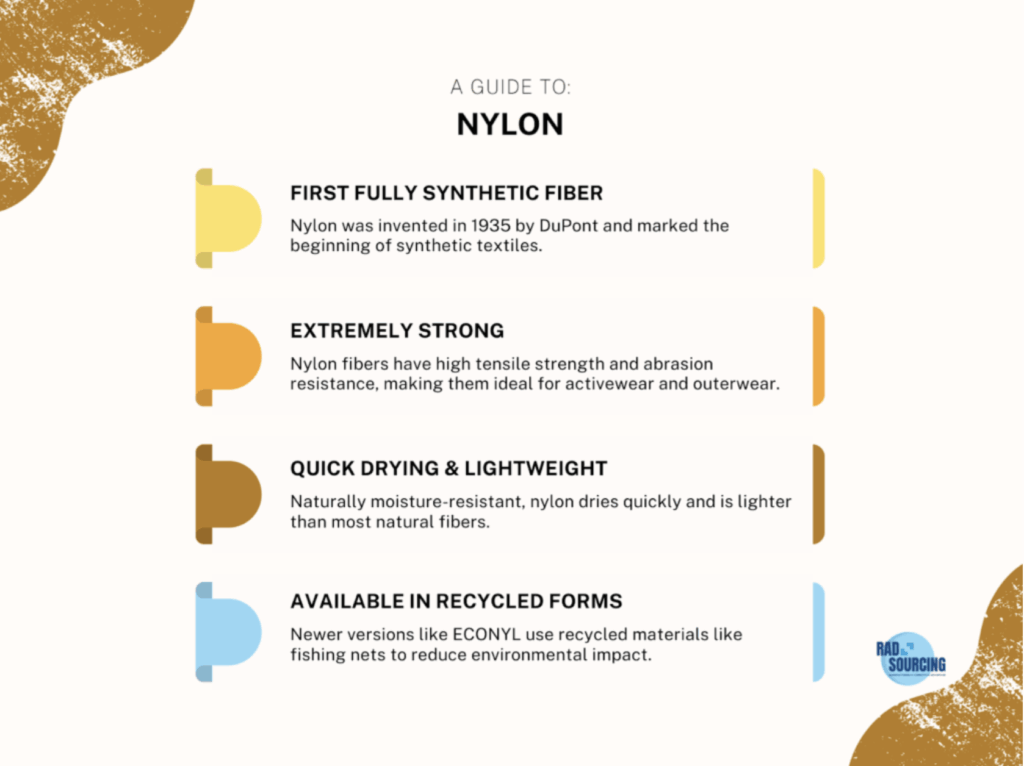
In response to these concerns, the textile industry has begun investing in more sustainable nylon alternatives. Recycled nylon, often made from post-industrial waste or reclaimed materials such as fishing nets and fabric scraps, is gaining traction. ECONYL® is one such brand that regenerates nylon waste into new fibers with significantly reduced environmental impact. Although recycling nylon does not eliminate all of its sustainability challenges, it offers a meaningful reduction in carbon emissions and diverts waste from landfills and oceans.
Nylon is produced globally, with major manufacturing centers in Asia (especially China, Taiwan, and India), Europe, and the United States. Due to its versatility, it is used across multiple industries beyond fashion, including automotive parts, ropes, carpets, tents, and medical equipment. It blends well with other fibers, such as spandex (also known as elastane), cotton, and polyester, to enhance its performance characteristics.
While nylon offers unparalleled durability and performance, it also serves as a case study in the environmental costs of synthetic innovation. As sustainable technologies evolve and consumer demand for eco-conscious materials grows, nylon’s future will likely depend on the expansion of closed-loop systems and continued investment in recycled alternatives.