
Spandex, also known as elastane outside the United States, is a synthetic fiber celebrated for its unparalleled elasticity. The name “spandex” is an anagram of the word “expands,” and it accurately captures the fiber’s unique ability to stretch many times its length and then snap back to its original form. Invented in 1958 by Joseph Shivers at DuPont, spandex was initially created to replace rubber in stretchable clothing applications. It quickly found its way into activewear, undergarments, swimwear, and beyond, becoming an essential component of modern fashion and performance textiles.

The invention of spandex was revolutionary because it gave textiles a new dimension of comfort and fit. Unlike rubber, spandex is lighter, more durable, and resistant to perspiration and body oils. By the 1960s, spandex had gained commercial momentum, particularly in women’s fashion, hosiery, and athletic apparel. The fiber helped redefine garment construction by allowing designers to create form-fitting, body-conscious clothing that moved with the wearer rather than restricting them.
The production of spandex involves several chemical and mechanical stages. It begins with the formation of a prepolymer, which occurs when a diisocyanate reacts with a macroglycol. This prepolymer is then chain-extended using a diamine to produce a polyurethane-based polymer with highly elastic properties. The polymer solution is dissolved in a solvent and extruded through spinnerets using the solution dry spinning method. As the fibers pass through a chamber of warm air, the solvent evaporates, leaving solid elastic filaments. These filaments are treated with finishing agents to improve handling and blending and are wound onto spools for use in textile production.
Spandex is rarely used alone in fabrics. Instead, it is typically blended in small amounts (ranging from 2% to 20%) with other fibers, such as cotton, polyester, or nylon. Even at low percentages, spandex dramatically improves the stretch, comfort, and shape retention of garments. This blending makes spandex a staple in yoga pants, leggings, sports bras, swimsuits, socks, jeans, and compression garments.
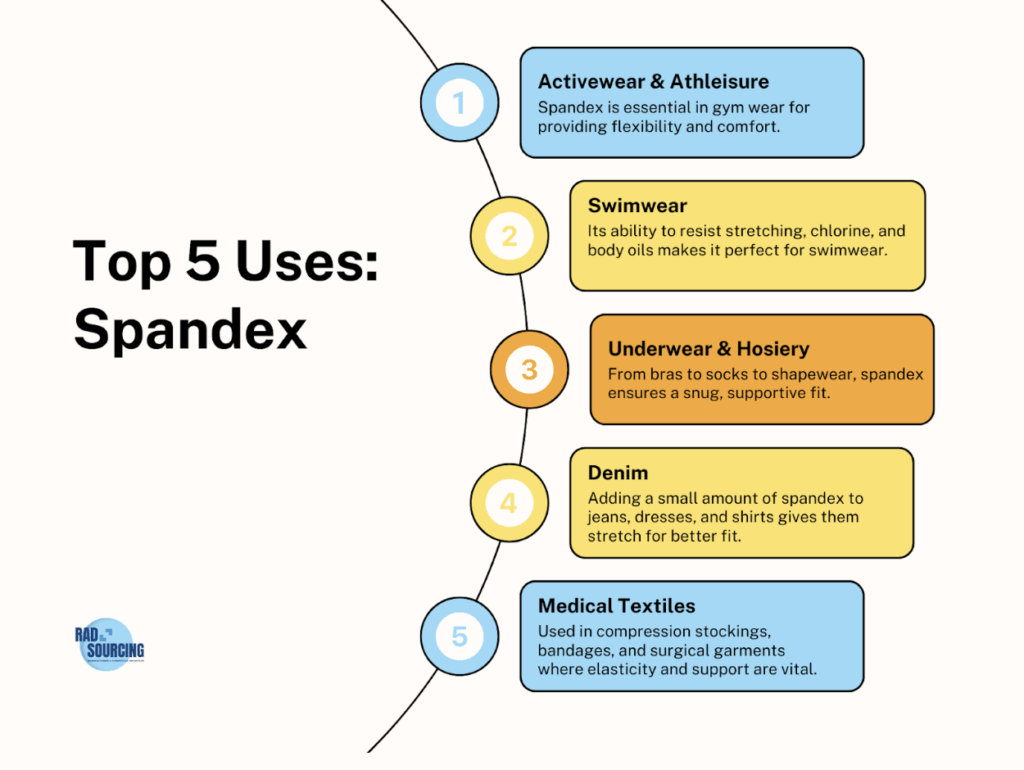
The fiber’s key properties include its extraordinary elasticity, light weight, resistance to wear and tear, and ability to withstand repeated stretching without losing shape. It also resists perspiration, body oils, and lotions, making it exceptionally durable in everyday wear. In medical applications, spandex’s stretch is invaluable in products like compression stockings, surgical hose, and bandages.
From a sustainability perspective, spandex faces challenges. It is a petroleum-derived synthetic fiber that is not biodegradable, meaning it persists in landfills for centuries. Its production requires toxic chemicals, including diisocyanates, which must be carefully managed to avoid environmental and health hazards. Furthermore, when blended with natural fibers, spandex makes textile recycling more difficult, as separation is complex and often uneconomical. Spandex can also contribute to microplastic pollution when garments are washed.
Efforts are underway to improve spandex’s environmental profile. The LYCRA Company and other producers have begun developing recycled versions of spandex, such as LYCRA® EcoMade, which use pre-consumer or post-industrial waste. Research into bio-based spandex, derived in part from renewable resources such as corn, is also emerging, although it is not yet widespread. Certifications such as OEKO-TEX can ensure that spandex fibers and blends are tested for harmful substances, providing consumers with some reassurance about safer production standards.
Despite its environmental drawbacks, spandex remains indispensable in modern apparel due to its functional benefits. Its ability to stretch and recover revolutionized fashion, giving rise to entirely new categories of performance wear, athleisure, and body-conscious clothing. Designers continue to rely on spandex for its role in providing comfort, mobility, and style.
Spandex is more than just a fiber; it is a key enabler of the way people dress and move today. While its environmental challenges remain significant, innovation in recycling and the development of bio-based alternatives offer hope for a future where spandex can continue to deliver comfort and performance with a lighter ecological footprint.